
Brighton's 1952 Palm House reopens as butterfly house amid UK 'Butterfly Emergency'
A restored Hartleys glasshouse at One Garden Brighton has been turned into a tropical flight cage. The opening lands as wild UK butterflies hit record lows.

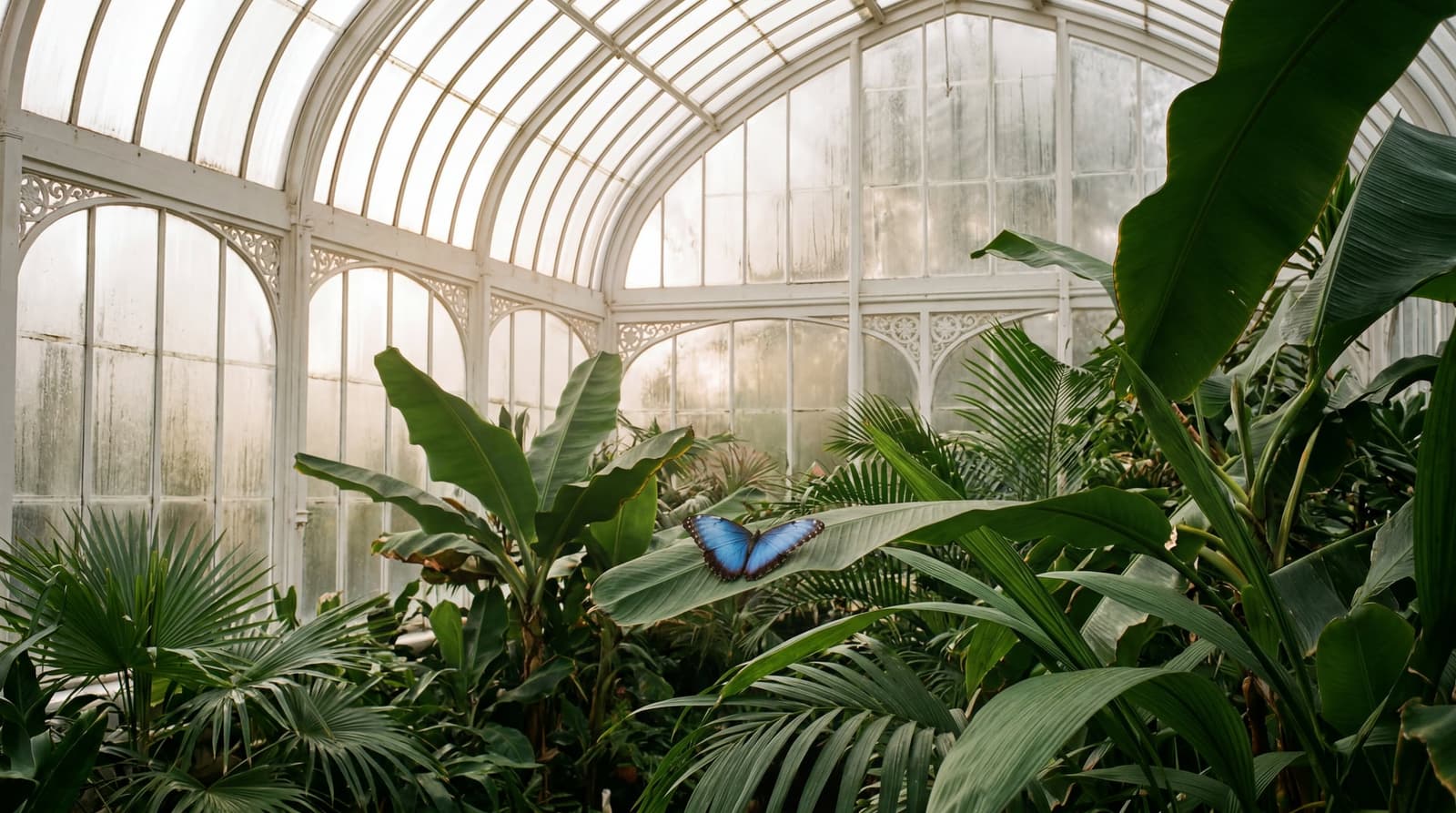
A new tropical butterfly house opened to the public on Saturday inside a restored 1952 Palm House at One Garden Brighton in Stanmer Park, the venue's operators said. The Sussex Butterfly Gardens unlocked the doors at 10am on 23 May to catch the May half-term crowd, with hundreds of exotic butterflies, moths and invertebrates flying free among tropical planting inside the climate-controlled glasshouse.
The attraction is a three-way collaboration between Plumpton College, which owns and manages One Garden Brighton; Matthew Simmonds, who already runs butterfly houses in Ditchling and London; and Beth Brockwell, a former Plumpton Animal Management student now working on the project. Plumpton has pitched the site as both a paying visitor attraction and a "living classroom" for its students, according to the college.
The BBC's coverage of the launch described the site as home to "thousands" of butterflies. The operators' own materials and Plumpton College say "hundreds." Asked about the figure, the venue's published press release sticks with the lower number.
A Hartleys glasshouse, brought back
The building itself is arguably the bigger story. The Palm House at One Garden Brighton is one of only three surviving 1950s Victorian-style glasshouses designed by Hartleys, the Greenford firm that supplied much of mid-century Britain's botanical glazing. It had fallen out of active use before Plumpton struck the partnership to restore it.
Restoration means more than new glass. To keep tropical species alive year-round in Sussex, the structure has been fitted out to hold a warm, humid microclimate, which also sustains the nectar and host plants the insects feed and lay eggs on, One Garden Brighton said.
Simmonds is not new to the format. His existing Sussex Butterfly Gardens site at Middleton Common Farm in Ditchling carries a roughly 3,000 sq ft tropical flight area with hundreds of free-flying butterflies and moths, according to the operator. He also founded London Butterfly Gardens. The Brighton site is, in effect, the third venue in a small chain.
The pitch: tourism plus training
For Plumpton, a land-based further-education college in East Sussex, the appeal is the student work placement. Horticulture and animal-management students will rotate through the glasshouse alongside paying visitors, handling planting, husbandry and front-of-house duties inside a live commercial attraction.
"This project is defined by its synergy; by working alongside One Garden Brighton and Plumpton College, we are creating a fully immersive visitor attraction. It offers an interactive jungle experience for the public while providing students with hands-on experience in a truly unique environment."
Matthew Simmonds, founder, Sussex Butterfly Gardens
Plumpton, in a project statement, called Simmonds' expertise a draw and singled out the involvement of former student Brockwell as making the partnership "a very special project."
The backdrop nobody in the press release mentions
The launch lands at an awkward moment for British butterflies. The 2024 results from the UK Butterfly Monitoring Scheme, run by Butterfly Conservation, UKCEH, BTO and the Joint Nature Conservation Committee, ranked last year the fifth worst on record for wild UK butterflies. The data show 31 of 59 resident species in long-term decline, with nine species, including the Small Tortoiseshell, Chalk Hill Blue and Small Copper, hitting their worst-ever counts, JNCC reported.
Butterfly Conservation went further. After the 2024 Big Butterfly Count recorded the lowest average numbers in the citizen-science survey's 14-year history, the charity formally declared a UK "Butterfly Emergency," blaming habitat loss, pesticides and climate-driven extreme weather, Butterfly Conservation said.
"I am devastated by the decline of our beloved British butterflies, and I'm sorry to say it has been brought about by human actions: we have destroyed wildlife habitats, polluted the environment, used pesticides on an industrial scale and we are changing the climate."
Dr Richard Fox, head of science, Butterfly Conservation
The species under the Palm House glass at One Garden Brighton are not the species in the JNCC's decline columns. Tropical butterfly houses display farmed exotics, typically sourced from breeding operations in Central and South America and Southeast Asia, and the insects do not, and cannot, establish in the wild in the UK. The conservation case for these attractions is therefore indirect: education, engagement, and the chance to put a child a few inches from a live Morpho.
Whether that translates into action for native species is contested. A 2024 review by Butterfly Conservation argued the most pressing UK interventions are habitat restoration, pesticide reduction and climate mitigation, not captive display. Operators of butterfly houses counter that public exposure drives membership, donations and behaviour change.
What visitors get
The glasshouse is open daily during the half-term week, with ticketing handled through One Garden Brighton. The site sits inside Stanmer Park, the publicly owned country park on the northeastern edge of Brighton, which is free to enter on foot.
A few practical points worth flagging:
- The flight area is humid and warm year-round, which is hard on cameras and on visitors in heavy coats.
- Strollers are permitted but the planting is dense.
- The site doubles as a working teaching facility, so some areas may be closed to the public when classes are running.
For Plumpton, the test now is whether the "living classroom" framing holds up past the launch weekend, and whether the restored Hartleys glasshouse becomes a fixture of Brighton's visitor economy or a footnote in a long list of well-intentioned heritage reuses. For Simmonds, it is a third site in a portfolio that is quietly becoming one of the larger butterfly-house operations in the south of England.
For the wild British butterflies outside the glass, the picture is bleaker and largely unchanged by Saturday's opening.
Related stories
Northern Ireland's rarest rainforest gets a 100-year reboot in Tyrone
Ulster Wildlife has planted nearly 30,000 native trees at Lenamore Wood, the first Northern Irish site in Aviva's £38.9m Celtic Rainforest programme. The genetic detail matters more than the photo op.
Four Jersey beaches flunk bacteria tests as island bakes in record May heat
Officials blame rainfall runoff for 'poor' water quality at Plemont, Grouville, Havre des Pas and Victoria Pool, even as Jersey breaks its all-time May temperature record.
SpaceX's Starship V3 ends in planned Indian Ocean fireball, two days after $80B IPO filing
Flight 12 broke a seven-month launch drought and delivered most of its test goals. The timing, just 48 hours after SpaceX's S-1 hit the SEC, gave the spectacle a second audience: Wall Street.
Somerset's fox count just doubled in 10 days. That's a problem.
A county citizen science project logged more red foxes in a week and a half than official records typically capture in two years, exposing a structural blind spot in how Britain monitors its most familiar wildlife.
Keep Reading
Juliann Bluitt Foster, Trailblazer in Dentistry, Is Dead at 80
UK's River Wye gets a rights charter. Will polluters notice?
The race to shrink the astronaut gym before Mars
Six eggs used to cost £1. Here's why they're now £2.
In Cambridge, a paycheck no longer keeps workers out of the food bank