




SpaceX's Starship V3 ends in planned Indian Ocean fireball, two days after $80B IPO filing
Flight 12 broke a seven-month launch drought and delivered most of its test goals. The timing, just 48 hours after SpaceX's S-1 hit the SEC, gave the spectacle a second audience: Wall Street.

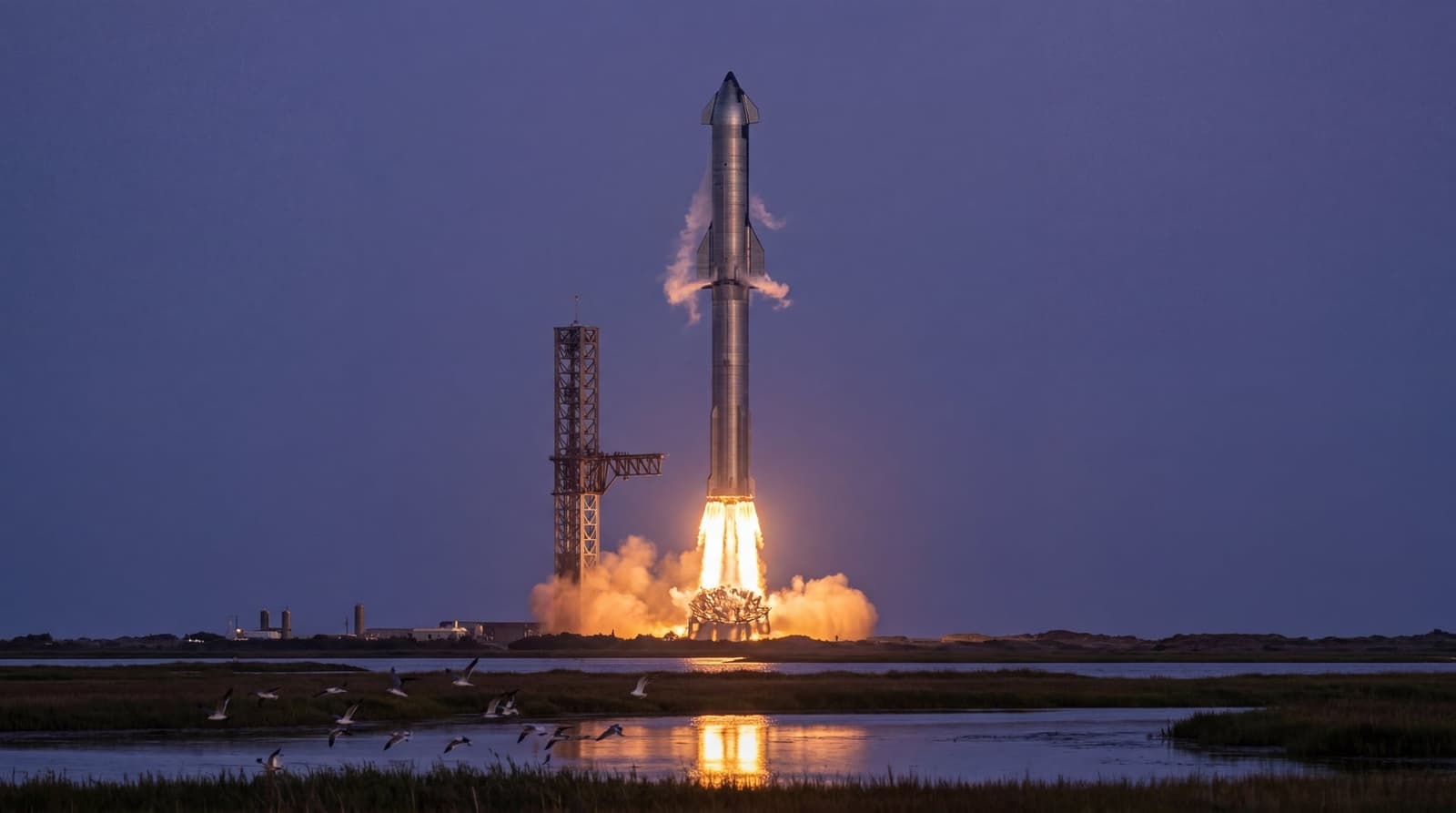
SpaceX flew its Starship megarocket for the first time in 2026 on Friday evening, and for the first time in its new Version 3 configuration, capping a roughly one-hour suborbital trajectory with a deliberate fiery splashdown in the Indian Ocean off Western Australia.
The 408-foot vehicle lifted off at 6:30 p.m. EDT from the newly commissioned Pad 2 at Starbase, Texas, according to Space.com's live coverage. The Ship 39 upper stage survived re-entry, deployed 22 mock Starlink satellites, relit two engines for a controlled flip and descent, then tipped over and exploded on contact with the water. None of that was an accident. SpaceX never intended to recover either stage on this maiden V3 flight.
What made the launch unusual wasn't the explosion. It was the calendar. SpaceX filed its IPO registration statement with the Securities and Exchange Commission on May 20, two days before the countdown clock started, seeking to raise as much as $80 billion at a roughly $2 trillion valuation under the ticker SPCX, SpaceNews reported. Flight 12 became, in effect, the first public demonstration of a vehicle that SpaceX's own S-1 describes as the key enabler of its growth story.
A test campaign restarted under investor eyes
Flight 12 broke a seven-month gap since Flight 11 in October 2025, the longest pause in the program's integrated-test era. It was also the debut of Block 3 hardware, a near-total architectural overhaul that retired the troubled V2 design after four upper-stage failures in 2025.
The new vehicle is powered by 33 Raptor 3 engines on the Super Heavy booster, producing roughly 18 million pounds of thrust, about double NASA's Space Launch System, Spaceflight Now reported. The sea-level Raptor 3 delivers around 280 tons of thrust, up roughly 22% from the Raptor 2. SpaceX has described V3 as the first configuration capable of in-orbit propellant transfer, the maneuver NASA's Artemis lunar architecture depends on.
Not everything worked. Ship 39 lost one of its six Raptor Vacuum engines during ascent. Super Heavy Booster 19 fared worse: only 29 of its 33 engines lit during the boostback burn, and the booster crashed hard into the Gulf of Mexico rather than executing its planned soft splashdown.
"I wouldn't call it nominal orbital insertion, but we're in on a trajectory that we had analyzed, and it's within bounds," SpaceX spokesperson Dan Huot said during the live broadcast. Later, as telemetry from the booster degraded, Huot was blunter: "The booster didn't complete its full boost back."
A rocket that doubles as a prospectus
NASA Administrator Jared Isaacman watched the launch from Starbase in person and posted his endorsement on X shortly afterward. His pre-launch comments to reporters were arguably more revealing.
We're looking forward to seeing this fly, because hopefully at some point in the not-too-distant future we're going to join up in Earth orbit.
That "join up" is the propellant-transfer demonstration NASA needs before any crewed Artemis Moon landing. The agency awarded SpaceX a $2.89 billion Human Landing System contract and is contractually counting on Starship to put astronauts back on the lunar surface by 2028. Independent estimates put the number of tanker flights required before a single crewed landing at somewhere between 8 and 15.
Elon Musk, for his part, struck the celebratory tone the IPO underwriters at Goldman Sachs, Morgan Stanley and Bank of America presumably wanted to see. "Congratulations @SpaceX team on an epic first Starship V3 launch & landing! You scored a goal for humanity," he posted, Spaceflight Now reported.
The S-1 puts numbers on what those tweets are selling. SpaceX spent $3 billion developing Starship in 2025, then another $930 million in the first quarter of 2026 alone, TechCrunch reported based on the filing. Starlink, which underwrites that spending, generated $11.4 billion in 2025 revenue with 10.3 million subscribers. The next-generation Starlink V2 satellites are too large for Falcon 9 and can only ride to orbit on Starship.
What the filing actually promises
Buried in the S-1 is a commitment that turns Friday's engine-out ascent from an engineering footnote into potential disclosure material: SpaceX has told prospective investors it will begin Starship payload delivery to orbit in the second half of 2026.
That's roughly six months from Flight 12. Between now and then, SpaceX needs to demonstrate booster recovery on V3 hardware, full upper-stage controllability with all engines firing, and eventually an actual payload deployment, not the 22 mock Starlink units released on this flight (two of which carried cameras, marking the first in-flight video recorded directly from the rocket).
The road to here has been rough. The first Block 3 booster, B18, was destroyed in a November 2025 ground-test gas-system failure. SpaceX assembled the replacement B19 in 25 days. A first launch attempt on Thursday was scrubbed when a hydraulic pin on the launch tower arm failed to retract with seconds left on the clock.
The competitive frame
Blue Origin, which holds the second Artemis lunar lander contract for its Blue Moon vehicle, will fly alongside Starship in the Artemis III architecture. The Federal Aviation Administration, which grounded Starship after Flight 7's debris field over the Turks and Caicos in January 2025 and Flight 8's explosion off Florida in March 2025, has so far signaled no concerns about Friday's planned ocean impact.
Across 12 integrated flights since April 2023, Starship's scorecard now stands at seven successes and five failures, according to Wikipedia's launch log. The next flight, whenever SpaceX files the paperwork, will land in a different environment. By then, the company may be weeks from pricing the largest tech IPO in history, and every Raptor that fails to relight will be visible not just to engineers but to the SEC's filing readers.
Related stories
Northern Ireland's rarest rainforest gets a 100-year reboot in Tyrone
Ulster Wildlife has planted nearly 30,000 native trees at Lenamore Wood, the first Northern Irish site in Aviva's £38.9m Celtic Rainforest programme. The genetic detail matters more than the photo op.
Four Jersey beaches flunk bacteria tests as island bakes in record May heat
Officials blame rainfall runoff for 'poor' water quality at Plemont, Grouville, Havre des Pas and Victoria Pool, even as Jersey breaks its all-time May temperature record.
Somerset's fox count just doubled in 10 days. That's a problem.
A county citizen science project logged more red foxes in a week and a half than official records typically capture in two years, exposing a structural blind spot in how Britain monitors its most familiar wildlife.
UK's River Wye gets a rights charter. Will polluters notice?
Herefordshire and Powys councils have adopted the first source-to-sea rights charter for a UK river. Campaigners and lawyers are already asking what it actually changes.
Keep Reading
The race to shrink the astronaut gym before Mars
Rare four-chick osprey brood hatches in Dorset as southern England recolonisation accelerates
Six eggs used to cost £1. Here's why they're now £2.
In Cambridge, a paycheck no longer keeps workers out of the food bank
Bionic arms for five-year-olds, a third thumb, and the 90% who get nothing