

Waymo Halts Robotaxis in 5 Cities as Flood Patch Fails in Atlanta
A software stopgap pushed to all 3,791 Waymo vehicles depended on National Weather Service alerts that arrived too late. The same day, Waymo also pulled every freeway route in the US.

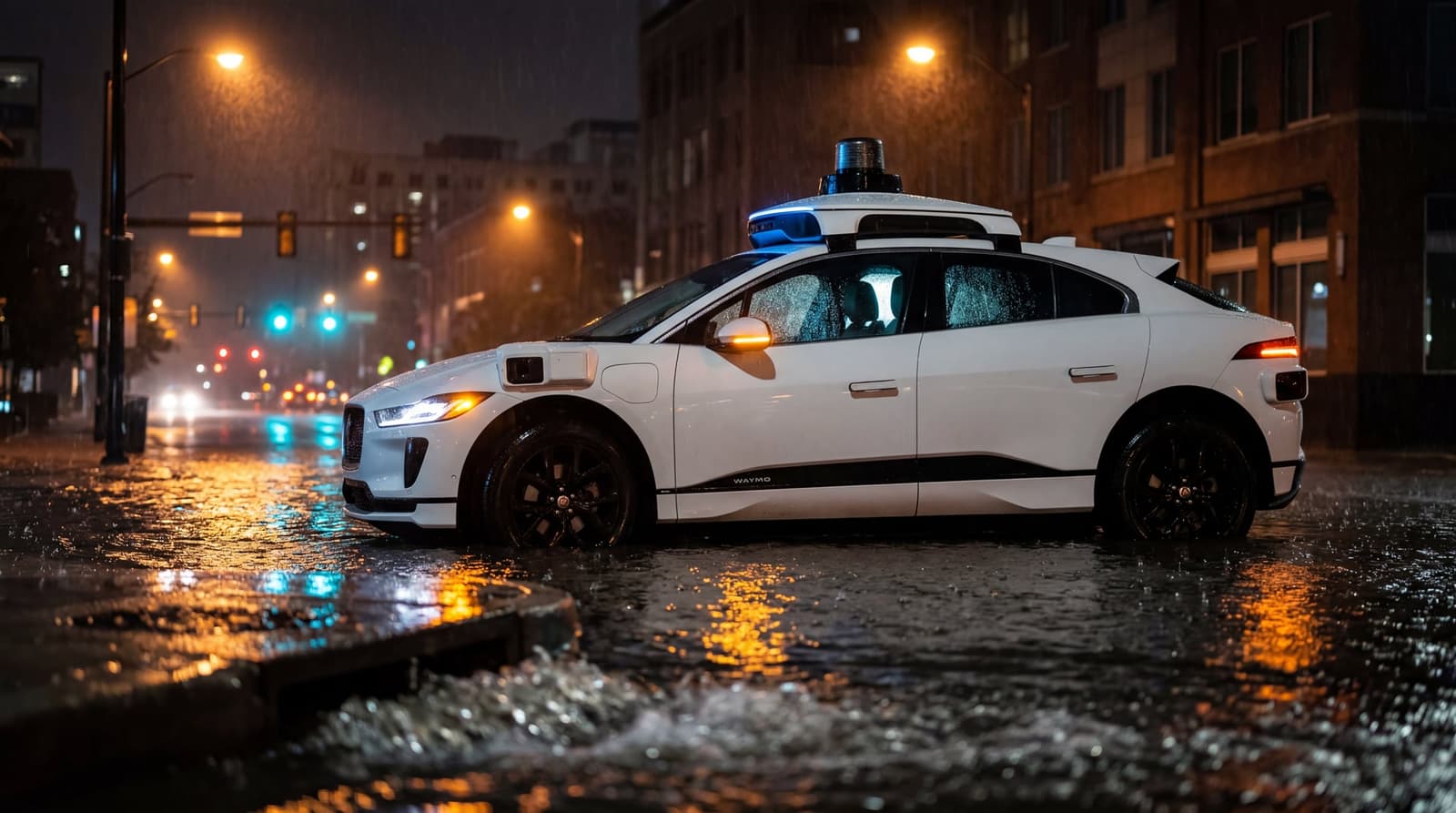
Waymo suspended robotaxi service in Atlanta, San Antonio, Dallas, Houston, and Austin on May 21 after one of its driverless vehicles rolled into a flooded Midtown Atlanta street during an overnight storm and sat stranded for roughly an hour before recovery crews pulled it out.
The pause came less than two weeks after the Alphabet-owned company issued a voluntary recall covering its entire 3,791-vehicle commercial fleet for the same defect: a flood-detection failure that has now produced at least three documented incidents in two states. A Waymo spokesperson told TechCrunch the company expanded the pause "out of an abundance of caution," and acknowledged in NHTSA filings that no permanent fix yet exists.
Hours later, Waymo separately suspended every US freeway route, in San Francisco, Los Angeles, Phoenix, and Miami, citing trouble with construction zones. Two unrelated service interruptions, announced the same afternoon, now affect riders in nine of the company's ten markets.
A patch built on a lagging signal
The May 6 recall, filed with the National Highway Traffic Safety Administration, described the underlying defect in unusually plain language. "On higher speed roadways, the Waymo AV may slow but not stop in response to detecting a potentially untraversable flooded lane," the company wrote in documents cited by the San Antonio Report.
Rather than wait for a permanent engineering fix, Waymo shipped an over-the-air patch that placed location and time-based restrictions on driving through high-risk flood zones. The trigger for those restrictions, the company told TechCrunch, includes alerts from the National Weather Service.
That is where the Atlanta failure becomes structural rather than incidental. The storm that flooded Midtown on the night of May 20 produced standing water before the NWS issued any flash flood warning, watch, or advisory. The patch was waiting for a signal that had not yet been broadcast.
Georgia Tech's Glen Chou told Atlanta News First that the sensor stack itself is part of the problem. LiDAR pulses reflect unpredictably off water surfaces. Camera-based depth estimation degrades in heavy rain. Radar is no better. The result is a known hard problem in autonomy research that Waymo's interim software cannot solve on its own, which is why the company leaned on external weather data in the first place.
The San Antonio escalation
The recall itself was triggered by an April 20 incident near Salado Creek in San Antonio, where an unoccupied Waymo entered a flooded 40 mph road, kept moving despite detecting water, and was swept downstream. Recovery took several days. Waymo paused all San Antonio service four days later and filed the recall on May 6.
In a statement to AccuWeather at the time of the recall, Waymo said it was "working to implement additional software safeguards" and "refining our extreme weather operations during periods of intense rain, limiting access to areas where flash flooding might occur." The Atlanta incident, one month later, suggests those mitigations did not extend to storms that develop faster than federal weather agencies can warn about them.
NHTSA confirmed it is watching. "NHTSA is aware of this incident, is in communication with Waymo, and will take appropriate action if necessary," an agency spokesperson told TechCrunch.
A widening regulatory file
The flood recall is Waymo's third since February 2024, after a 444-vehicle recall over two Phoenix robotaxis striking the same towed car and a 1,212-vehicle recall last May for low-speed collisions with barriers. It is not, however, the company's most serious open file with federal regulators.
NHTSA and the NTSB are running parallel investigations into a January 23, 2026 incident in Santa Monica, where a Waymo struck a child near Grant Elementary School. A separate dual-agency probe covers a pattern of robotaxis illegally passing stopped school buses. Austin Independent School District alone has logged at least 24 violations during the 2025–2026 school year, some of them after a December 2025 software recall that was supposed to fix the behavior.
On May 15, according to TechCrunch, NHTSA sent Waymo a second document request in the school bus case, telling the company its initial response "necessitates that [NHTSA] receive further data and information."
Waymo Chief Safety Officer Mauricio Peña has defended the company's record on school bus encounters, telling TechCrunch in January that "there have been no collisions in the events in question, and we are confident that our safety performance around school buses is superior to human drivers."
Expansion meets enforcement
The service pauses arrive at the most aggressive moment in Waymo's history. The company raised $16 billion at a $126 billion valuation in February, the largest autonomous-vehicle funding round on record, and is targeting one million paid rides per week by year-end, double its current run rate of roughly 500,000. Co-CEO Tekedra Mawakana told Bloomberg the company is "no longer proving a concept" but "scaling a commercial reality" with launches planned in more than 20 new cities, including Tokyo and London.
No federal regulator currently requires autonomous-vehicle operators to demonstrate flood-navigation performance before opening service in a new market. There is no equivalent pre-deployment standard for freeway construction zones, the issue behind the same-day highway suspension. The SF Standard reported that Waymo paused freeway operations "to integrate recent technical learnings," without specifying a restart date.
Mary Ellen Carroll, executive director of San Francisco's Department of Emergency Management, told the SF Standard that city agencies have been pulled into Waymo recoveries with increasing frequency.
In a sense, they're becoming a default roadside assistance service for these vehicles, which we do not think is tenable.
For riders in Atlanta, San Antonio, Dallas, Houston, and Austin, the practical effect is that Waymo will not be an option during what is shaping up to be an active storm season across the southern US. For Waymo, the harder problem is that the company has now told federal regulators, in writing, that it does not yet know how to make its cars stop for water, and its workaround depends on a warning system that the weather can outrun.
Related stories
Bionic arms for five-year-olds, a third thumb, and the 90% who get nothing
A BBC Tech Life episode showcases the bleeding edge of prosthetics. The harder story is who can actually use any of it.

Atlanta Residents Cheer AI Productivity, Fear the Job Cuts It Brings
A new Atlanta Regional Commission snapshot finds 61% of metro residents expect AI to boost productivity, but 73% expect it to shrink the job pool, just as city hall reviews live AI deployments.
Newsom's AI Workforce Order Buys Time as Layoffs Mount
California's governor ordered agencies to study AI's disruption to workers. Labor leaders say studying isn't action, and a tougher bill already sits on his desk.
SpaceX scrubs Starship V3 debut a day after filing $1.75T IPO
A hydraulic pin halted Flight 12 at T-40 seconds. The S-1 filed hours earlier names Starship as the prospectus's top risk.
Keep Reading

Northern Ireland's rarest rainforest gets a 100-year reboot in Tyrone
Four Jersey beaches flunk bacteria tests as island bakes in record May heat

Six eggs used to cost £1. Here's why they're now £2.
In Cambridge, a paycheck no longer keeps workers out of the food bank