




UK's River Wye gets a rights charter. Will polluters notice?
Herefordshire and Powys councils have adopted the first source-to-sea rights charter for a UK river. Campaigners and lawyers are already asking what it actually changes.

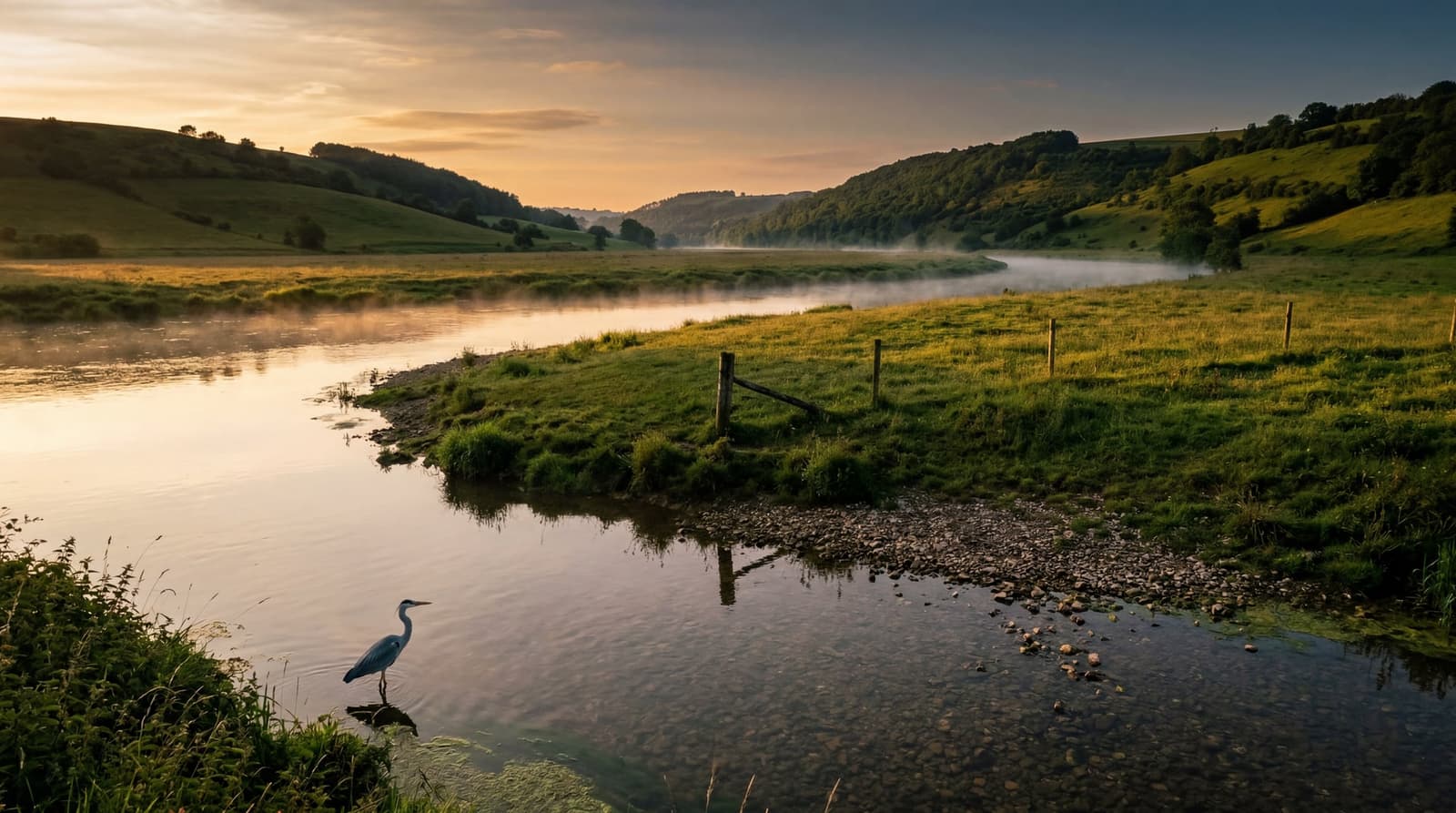
The River Wye is now the first river in the United Kingdom covered by a rights-based charter running its full length, after Powys County Council formally adopted the Charter for the Rights of the River Wye on 19 May 2026. The vote, by the Welsh authority's Liberal Democrat and Labour cabinet, completes a cross-border framework that began when Herefordshire Council endorsed the document in December 2025 and ratified it through cabinet in March 2026.
The six-point charter recognises the Wye's right to flow and perform natural functions, to biodiversity, to be free from pollution, to a healthy supporting catchment, to regenerate, and to representation. It was drafted by the Wye Catchment Nutrient Management Board and the River Wye Catchment Partnership with input from legal and environmental specialists, according to a report to Powys cabinet by Daniel Burgess, the council's head of economy and climate.
A public launch is scheduled for 24 May at a community event tied to the Hay Festival, on the riverbank.
A milestone with an asterisk
The charter does not grant the Wye legal personhood. It does not override planning law. It does not, on its own, force any farm, factory or water company to do anything differently. Both councils have committed instead to embed its principles in planning and land management decisions, a softer instrument than the statutory rights enjoyed by New Zealand's Whanganui River since 2017 or Colombia's Atrato.
Herefordshire's deputy leader was unusually candid about the limits.
That admission, buried in the joint press materials, is the crux of the story. Supporters argue the charter is a values statement that will steer hundreds of small decisions, from drainage consents to agricultural grants. Critics worry it offers political cover at a moment when the river needs enforcement, not affirmation.
Why the urgency
The Wye is among the most legally protected rivers in Britain, designated both a Special Area of Conservation and a Site of Special Scientific Interest. Its condition has nonetheless collapsed. In May 2023, Natural England downgraded all seven English units of the river from "unfavourable, recovering" to "unfavourable, declining," citing measured losses of Atlantic salmon, white-clawed crayfish and aquatic plants. More than 90% of the river's signature Ranunculus water-crowfoot beds have been lost since 2020, smothered by algal blooms that turn the water opaque green in summer.
The driver is phosphorus. Environment Agency source modelling, summarised by consultants Hydrosolutions, attributes 72 to 74% of the daily phosphate load to rural land use, principally livestock manure, with sewage treatment works contributing a further 21 to 23%. Researchers at the Universities of Lancaster and Leeds calculated that total manure phosphate produced in the catchment exceeds the needs of local crops and grassland by 45%. River Action estimates roughly 24 million poultry birds are reared in the Wye Valley at any one time, about a quarter of total UK output.
The lawsuit running alongside
While councillors debated rights language, a different kind of pressure was already in court. A High Court class-action against poultry firms Avara Foods and Freemans of Newent, and water utility Welsh Water, alleging phosphorus, nitrogen and bacterial pollution from manure runoff and sewage discharges, held its first case management hearing in April 2026, Nation Cymru reported. The defendants deny the claims.
That case follows River Action's 2024 judicial review, in which a judge ruled the Environment Agency had misinterpreted the Farming Rules for Water and that, in the campaign group's paraphrase of the judgment, farming practices on the Wye "will have to change."
The contrast with the charter is sharp. Litigation extracts disclosure, sets precedent and, if successful, awards damages. A charter sets a tone.
What the charter could actually do
Lawyers tracking the global rights-of-nature movement (the House of Commons Library counted about 115 freshwater initiatives worldwide in a May 2026 briefing) say non-statutory charters can still bite in three practical ways.
- They give planning officers a documented basis to weight ecological harm in decisions on poultry units, housing and sewerage infrastructure.
- They create a reference text that campaigners and statutory consultees can cite when challenging consents.
- They establish a representative voice for the river itself, the sixth right in the Wye charter, which can be formalised through guardians or advisory panels.
None of that is enforcement. But all of it shapes the discretionary space in which councils operate, and the Wye crosses dozens of decision points each year that fall within that discretion.
Jamie Audsley, chief executive of Herefordshire Wildlife Trust, said when the 2023 downgrade was announced that "current approaches have failed to keep the River Wye in a healthy condition. What we now need to see is a cross government plan to bring the Wye back into a favourable condition," according to a Wildlife Trusts statement. The charter is not that plan. It is, at most, a scaffolding for one.
A test case for English and Welsh rivers
The Wye is not the first English river to receive local rights recognition. The River Ouse in Lewes secured a similar council declaration in 2023, and authorities in Hampshire followed. What is new is the source-to-sea scope and the cross-border alignment between an English unitary authority and a Welsh county council, a coordination that has eluded regulators on the Wye for years.
For Powys, the political signal matters. "By adopting this charter, we are making a clear statement that the river's health matters and must be protected," the council said in its adoption statement.
Whether the statement converts into cleaner water will depend on the planning decisions of the next few years, the outcome of the High Court action, and whether ministers in Westminster and Cardiff translate the principle into statute. Until then, the Wye has rights on paper, algal blooms in the water, and a court date in the diary.
Related stories
Northern Ireland's rarest rainforest gets a 100-year reboot in Tyrone
Ulster Wildlife has planted nearly 30,000 native trees at Lenamore Wood, the first Northern Irish site in Aviva's £38.9m Celtic Rainforest programme. The genetic detail matters more than the photo op.
Four Jersey beaches flunk bacteria tests as island bakes in record May heat
Officials blame rainfall runoff for 'poor' water quality at Plemont, Grouville, Havre des Pas and Victoria Pool, even as Jersey breaks its all-time May temperature record.
SpaceX's Starship V3 ends in planned Indian Ocean fireball, two days after $80B IPO filing
Flight 12 broke a seven-month launch drought and delivered most of its test goals. The timing, just 48 hours after SpaceX's S-1 hit the SEC, gave the spectacle a second audience: Wall Street.
Somerset's fox count just doubled in 10 days. That's a problem.
A county citizen science project logged more red foxes in a week and a half than official records typically capture in two years, exposing a structural blind spot in how Britain monitors its most familiar wildlife.
Keep Reading

The race to shrink the astronaut gym before Mars
Rare four-chick osprey brood hatches in Dorset as southern England recolonisation accelerates

Six eggs used to cost £1. Here's why they're now £2.
In Cambridge, a paycheck no longer keeps workers out of the food bank

Bionic arms for five-year-olds, a third thumb, and the 90% who get nothing