



NASA Pushes Artemis Accords Into Latin America as Signatory Count Hits 67
The Lima workshop, the first held in South America, follows six rapid signings and a $20 billion U.S. commitment to a permanent Moon Base.

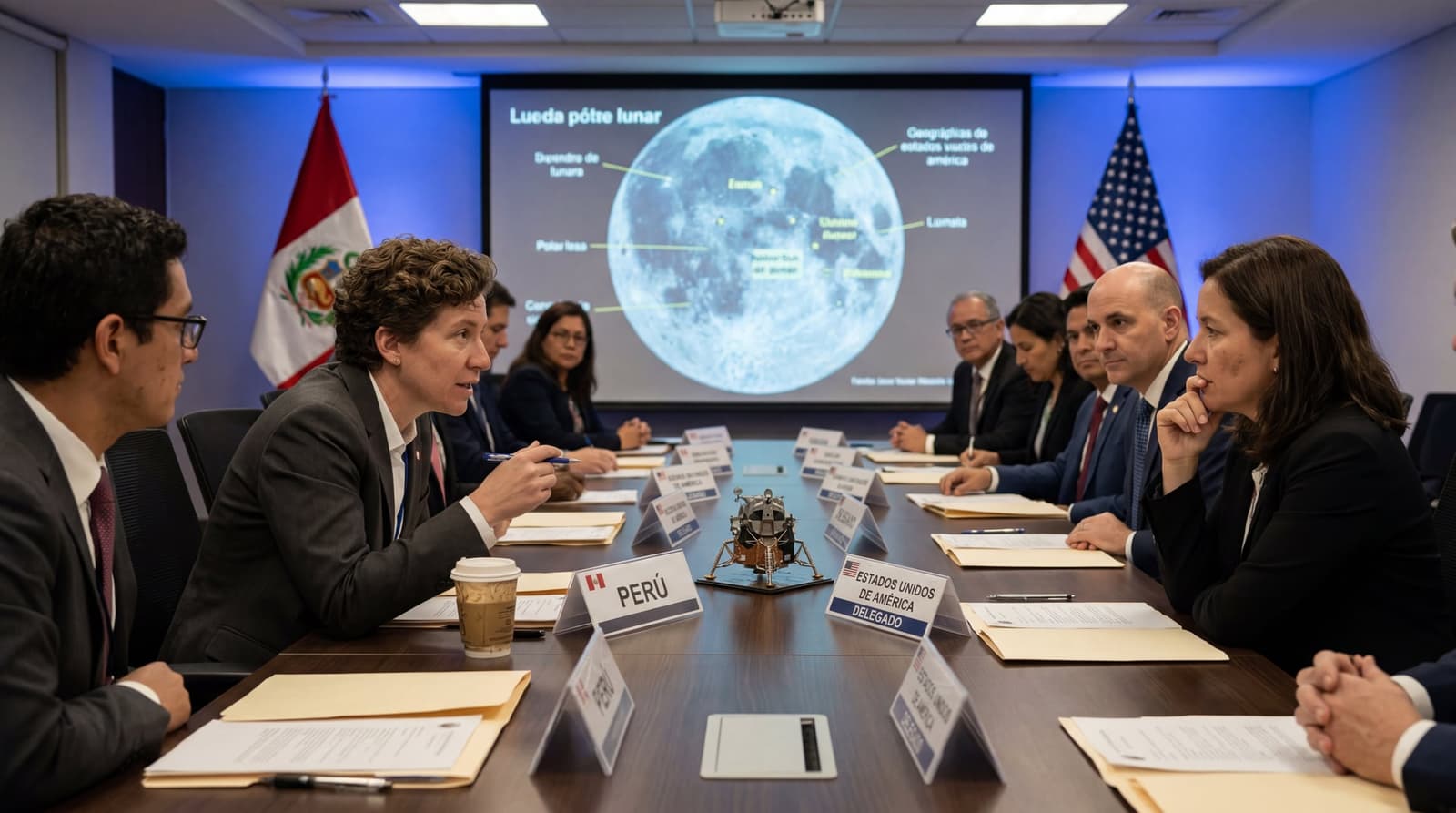
NASA and the U.S. State Department convened the Fourth Artemis Accords Workshop in Lima on May 13-14, the first time the annual gathering has been held in South America, as the diplomatic framework's signatory count climbed to 67 nations. Representatives from 30 countries attended in person or virtually, working through tabletop exercises on non-interference, interoperability, orbital debris and scientific data sharing, NASA said in a press release.
The Peru meeting capped an 18-day stretch in which six countries signed the Accords: Latvia on April 20, Jordan on April 23, Morocco on April 29, Malta and Ireland on May 4, and Paraguay on May 7. Morocco became the first North African nation to join, signing in Rabat during a visit by U.S. Under Secretary of State Christopher Landau, Atalayar reported.
The signings did not happen in isolation. They followed two events that have reset the diplomatic stakes around lunar exploration: NASA Administrator Jared Isaacman's March 24 unveiling of the Ignition initiative, which committed roughly $20 billion over seven years to a permanent Moon Base at the lunar south pole, and the successful Artemis II crewed lunar flyby from April 1-10, which sent four astronauts farther from Earth than any humans in history.
A causal chain, not a coincidence
"This gathering showcases the remarkable global momentum behind the Artemis Accords and our Artemis program," Isaacman said in NASA's statement on the workshop. He has framed the broader effort in starker terms when speaking about Ignition, warning that "the clock is running in this great-power competition, and success or failure will be measured in months, not years."
That urgency is the through-line connecting the spring's events. Artemis II's crew, including NASA astronauts Reid Wiseman, Victor Glover and Christina Koch and Canadian astronaut Jeremy Hansen, returned on April 10 after traveling 252,756 miles from Earth, the first humans to reach the vicinity of the Moon since 1972. Within days, the signings started rolling in.
Mike Gold, president of Redwire Space and one of the original architects of the Accords, was blunt about the driver.
Mike Gold, President, Redwire Space
Gold made the remark in comments to SpaceNews after Paraguay's signing. The Lima venue, paired with the Morocco and Jordan signings, fits a pattern: the State Department is steering the next phase of recruitment toward regions where Beijing has been actively courting partners.
The China counter-coalition
China's rival International Lunar Research Station (ILRS), co-led with Russia, has attracted 13 signatories including Pakistan, Belarus and South Africa, according to The Diplomat. With the lone exception of Thailand, no country has signed both frameworks. The two coalitions are hardening into distinct blocs.
That backdrop helps explain why a workshop ostensibly devoted to technical coordination drew foreign ministry officials and ambassadors, not just space agency engineers. The Accords are nonbinding, but in practice they have become a prerequisite for deeper participation in NASA-led lunar activity, including the new Moon Base.
"Each and every Artemis Accords signatory has the opportunity to play a meaningful role with NASA as we work together to build a sustained human presence on the surface of the Moon," Isaacman said in NASA's workshop statement.
U.S. Ambassador to Peru Bernie Navarro echoed the pitch in his opening remarks, telling delegates that "every nation represented in this room, and every nation that joins us, has the opportunity to contribute meaningful science, hardware, and other capabilities in pursuit of this Moon Base endeavor," according to the U.S. Embassy in Lima.
What Lima actually produced
The workshop's substantive output went beyond speeches. Delegates ran tabletop exercises on lunar surface coordination ahead of more than a dozen anticipated lunar landing missions in the next 18 months, a cadence that will quickly stress-test the Accords' principles on non-interference and interoperability.
Peru's Foreign Affairs Ministry also surfaced a proposal to share critical lunar mission data through a decentralized database supported by the United Nations Office for Outer Space Affairs. The idea, if adopted, would give the Accords a technical infrastructure layer it currently lacks, and a U.N. imprimatur that could blunt long-running criticism from Moscow and Beijing that the framework is U.S.-centric.
Maj. Gen. Roberto Melgar Sheen, director of Peru's space agency CONIDA, said "all South American signatory countries are taking part in this event, with 90% participating in person and 10% virtually," a turnout he framed as evidence of the region's deepening engagement. Peru joined the Accords in 2024 and co-hosted the workshop with NASA and the State Department.
"Peru joined the Artemis Accords in 2024, aiming to participate in a cutting-edge dialogue mechanism that addresses global trends in space exploration," said Felix Denegri, Peru's vice minister of foreign affairs, in NASA's release.
The gap the workshop didn't close
For all the diplomatic choreography, one substantive issue remained unresolved in Lima: the legal status of private-sector resource extraction on the Moon. The Accords endorse the legality of space resource utilization in principle, but they do not establish a binding regime for commercial operators, and no workshop to date has produced one. With companies including Intuitive Machines, Astrobotic and a wave of international entrants planning surface missions in the next 18 months, the question of who can extract what, and under what oversight, is moving from theory to operations.
Legal scholars writing in Lawfare have flagged the gap repeatedly. The Accords were never designed as a treaty, and U.S. officials have shown little appetite to renegotiate the 1967 Outer Space Treaty that underpins them. That leaves the framework as a coalition-building tool first and a regulatory instrument a distant second.
For now, the coalition-building is working. From eight founding signatories in October 2020 to 67 today, the Accords have grown faster than any comparable space-governance arrangement. The next test is whether the framework can hold together once the landers, and the commercial operators behind them, actually start arriving at the south pole.
Related stories
Northern Ireland's rarest rainforest gets a 100-year reboot in Tyrone
Ulster Wildlife has planted nearly 30,000 native trees at Lenamore Wood, the first Northern Irish site in Aviva's £38.9m Celtic Rainforest programme. The genetic detail matters more than the photo op.
Four Jersey beaches flunk bacteria tests as island bakes in record May heat
Officials blame rainfall runoff for 'poor' water quality at Plemont, Grouville, Havre des Pas and Victoria Pool, even as Jersey breaks its all-time May temperature record.
SpaceX's Starship V3 ends in planned Indian Ocean fireball, two days after $80B IPO filing
Flight 12 broke a seven-month launch drought and delivered most of its test goals. The timing, just 48 hours after SpaceX's S-1 hit the SEC, gave the spectacle a second audience: Wall Street.
Somerset's fox count just doubled in 10 days. That's a problem.
A county citizen science project logged more red foxes in a week and a half than official records typically capture in two years, exposing a structural blind spot in how Britain monitors its most familiar wildlife.
Keep Reading
Juliann Bluitt Foster, Trailblazer in Dentistry, Is Dead at 80

UK's River Wye gets a rights charter. Will polluters notice?
The race to shrink the astronaut gym before Mars

Six eggs used to cost £1. Here's why they're now £2.

In Cambridge, a paycheck no longer keeps workers out of the food bank